
 Quick access: read our short summary and full report.
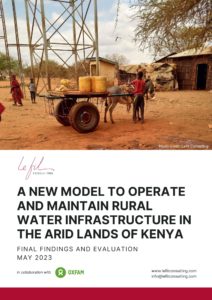
In the harsh, arid landscapes of northern Kenya, water infrastructure is crumbling fast: water schemes face a high rate of failure within a few years of construction. Within three to five years, nearly two-thirds of rural water systems become largely dysfunctional. On top of that, at any given time about a third are completely non-functional. This represents a colossal waste of investments and resources, placing already very vulnerable populations at the mercy of even more frequent and severe drought episodes without nearby access to water.
One of the main reasons for this problem is the lack of appropriate resources and expertise to conduct Operations and Maintenance (O&M). Today, money goes into paying for new or renewed infrastructure, and local communities are mostly left on their own to manage their water scheme after installation. This means that these rural, disconnected and low-income communities need to set up processes and teams to collect tariffs, run sometimes technically complex systems, and figure out ways to repair them whenever there is a break-down. At that stage, the tariff collected is typically insufficient and the community does not know how to address the problem best, or where to find help.
In light of this situation, LeFil Consulting and Oxfam, with the financial backing from several donors, co-developed an innovative, alternative and possibly better approach to perform O&M. This approach notably consisted in hiring a professional and cost-effective private O&M operator, introducing digital tariff collection, and centrally managing it. The new model was piloted in 60 water systems in Turkana County and another 30 water systems were used as a control group, making this one of the largest O&M improvement pilots ever attempted in Kenya.
The results of this pilot are very encouraging!
- the new model managed to increase the proportion of operational water systems by more than 30% over a year, compared to the status quo
- the pilot yielded significant monetary savings through the avoidance of massive breakdowns of infrastructure; however, these are not yet entirely enough to pay for the O&M provider’s fees
- a more centralized management of water infrastructure led to much faster, cheaper and better emergency responses during drought time.
In conclusion, it is time to rethink the paradigm about how to deliver O&M in rural, remote communities. Check our short summary and full report to access all detailed recommendations and learnings, and help improve, replicate and scale our efforts!
Interested in findings in Asia? See our past work on water infrastructure O&M approaches in Nepal.

