
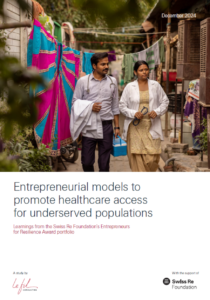
 Quick access: read the executive summary and full report.
Lack of access to essential healthcare remains a pressing issue globally, affecting nearly half of the world’s population. The Swiss Re Foundation, in collaboration with LeFil Consulting, has taken a leading role in addressing this challenge through the Entrepreneurs for Resilience Award (E4RA) programme: As part of this endeavour, from a pool of over 1,000 inclusive healthcare ventures, 26 were distinguished for their innovative approaches to making healthcare more accessible and affordable, particularly for low-income populations.
After five years of continuous investment in the sector, LeFil Consulting and the Swiss Re Foundation conducted a comprehensive analysis of all the data accumulated across shortlisted ventures, evaluating over 150 data points across four key dimensions: users and impact, scale and scalability, financial sustainability and additionality of support. This unprecedented dataset offers deep insights into the operational models, strengths, and challenges of leading healthcare ventures serving low-income populations across Africa, Asia, and Latin America.
The study analyses learnings from 26 health-focused ventures categorized into three distinct clusters, each reflecting a unique approach to improving healthcare access:
Cluster 1 – Affordable and accessible healthcare provision
- Sub-cluster 1.a – Centralised healthcare provision: These ventures operate through networks of physical medical facilities in densely populated areas.
- Sub-cluster 1.b – Decentralised healthcare provision: These ventures deliver healthcare services closer to the patient, using mobile clinics, telemedicine, or home visits.
Cluster 1 ventures are the strongest performing ones in the study. While they achieve promising scale and financial sustainability, they demonstrate the highest impact, generating greater net additional value (NAV) per user than other clusters.
Cluster 2 – Financial solutions for healthcare
- Sub-cluster 2.a – Third-party product underwriting: Ventures that distribute insurance products underwritten by external insurers.
- Sub-cluster 2.b – In-house product ownership/underwriting: These ventures develop and own their financial solutions, such as micro-insurance, savings wallets, and microloans.
Cluster 2 ventures serve a high proportion of low-income beneficiaries but operate on a smaller scale. While they show rapid growth potential, additional investment is critical to unlocking their full impact.
Cluster 3 – Technology solutions for the healthcare ecosystem
- Sub-cluster 3.a – Technology for healthcare delivery: Ventures offering software solutions, such as electronic medical records and telemedicine, to improve healthcare delivery.
- Sub-cluster 3.b – Technology for healthcare financing: These ventures provide platforms to digitise operations for insurers and other payers, including billing, claims management, and patient registration.
Cluster 3 ventures achieve the largest scale, indirectly supporting healthcare delivery or healthcare financing players. However, their own financial sustainability remains a challenge, as they depend on significant external funding to pay for operations and fuel growth.
Explore this study to gain valuable insights into the potential of various healthcare models and how best support them. Access the executive summary and full report to learn more!

